|
Savage Model 25 Classic Sporter .223 Rifle 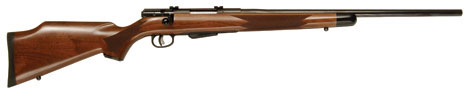 Savage Arms (www.savagearms.com) has built upon its experience with the .22 Hornet Model 40, its beautifully done “Classic” centerfire line, along with its hugely successful rimfire rifles and cooked up a new rifle. At a glance, the Model 25 Classic Sporter looks like the big brother to Savage’s 93R17 Classic .17 HMR. Looking closer, it is a lot more than that. This is a brand new, push feed, turnbolt action from Savage, stemming from neither their Model 40 nor their Model 110 actions. The receiver is apparently drilled from bar stock and the ejection port is a restricted, oval shaped opening on the right side. The Model 25 has a solid bolt (no floating bolt head) with three generous locking lugs at the front that make it more than suitably robust for this application. The bolt and receiver are extraordinarily long for such small cartridges. The bolt body extends for over 1/3 of its length behind the bolt handle and is encased in the equally long receiver, making the rear of the action bulkier than it needs to be. The barrel is threaded and pinned into the receiver, trapping the separate recoil lug between it and the front of the receiver. Cosmetically, the Model 25 shares some of the refinements we have come to expect in Savage’s Classic line: a walnut Monte Carlo stock with machine cut checkering, black fore end tip, jeweled bolt, pistol grip cap and highly polished blue metal finish. The barrel is free-floated and the receiver is dual pillar bedded in the standard grade walnut stock. Overall, this action is well suited to the chamberings in which it is offered: .204 Ruger and .223 Remington. It retains the Accu-trigger, with a two-position thumb safety at the right rear of the action in Remington Model 700 fashion. This Savage Accu-trigger breaks at 2 pounds, 11 ounces right out of the box. It felt so good that I have not bothered to tune it, although it is user adjustable. Here’s a looks at the basic specifications:
The magazine set-up appears to be new. Examine the magazine well and you will notice that the magazine fixture extending to and including the trigger guard is one integral piece. A polymer piece, to be honest, but well done. In gunland we have all kinds of code names for “plastic.” It can be composite, polymer, or synthetic. Maybe one day, someone will tell us a composite of what? In any case, as far as I am concerned, “plastic” does not tell me much. There is plastic wrap and then there are plastic materials of high strength or density, such as UHMWPE used to replace joints in the body or for body armor, to cite a couple of examples. Although I am a blued steel and walnut enthusiast, it is easy for me to grade the plastics used in ancillary gun parts: there is good and bad. I have a problem with visible mold lines and materials that are either unsightly or fragile. In the case of the Model 25’s magazine/trigger guard, it is aesthetically shaped and well fitted. Savage has a new structural polymer magazine that accompanies the Model 25. It has a four-shot capacity, loads and feeds like a dream and fits its mating surfaces well with no rattling. Inserted, it sits at an angle, with the rear of the magazine protruding maybe ¼" below the bottom line of the stock. Overall, this is an example of an appropriate use of polymer, adding the obvious functionality benefits (no corrosion, less weight) without being hard on the eyes. It is well done and most shooters won’t even notice. The Savage comes supplied with Weaver bases already installed, a thoughtful touch. I used Warne steel permanent rings to attach a Kahles CL 3-9x42 riflescope. With the 60-degree bolt lift of the Savage, scope mounting was a breeze. The Savage weighs just over 7 pounds unscoped; it is a light, responsive rifle. The Savage shot superbly right out of the box. When I flinched just right, the bullet holes touched. The Model 25 is an MOA gun with bulk American Eagle ammo and half-MOA with the right ammo. It is clearly a top value for the dollar and easy to work with from a scope mounting perspective. 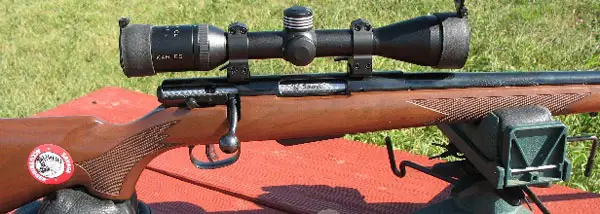 Reliability was 100% with all of the ammo I put into the magazine. The Savage’s plunger ejector tosses brass well away from the rifle regardless of bolt speed. I also appreciated that the Savage's safety was quieter in operation than previous clicky attempts. The lines of the Savage are clean and handsome, while the grip cap and jeweled bolt make it a stylish choice. I also liked the ability to place a single cartridge directly into the chamber, rather than having to feed only from the magazine, as in traditional Mauser 98 controlled feed actions. This new Savage action is appropriate for both the cartridge and all-around use. I would happily buy the Savage and I did. There was a time when my custom riflesmith friends held that light profile, mass-produced centerfires fed factory production ammo would shoot into two MOA or so, if you got a good one. Well, things have changed and this time for the better. The Savage Model 25 Classic Sporter gave me groups in the 3/4 MOA range with field ammo. I believe it will do the same for you, should you feel the need to acquire one. In fact, I can say with confidence that with proper load development and perhaps a touch of bedding, consistent 1/2 MOA performance is realistic. It’s not going to be nearly as safe to be a coyote in Illinois this coming year. |