|
THE Y2K HARLEY-DAVIDSON SUPER GLIDE SPORT By Chuck Hawks
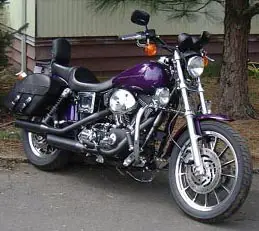
Harley calls it a sport model, motorcycle magazines call it a sport-cruiser and I call it a big standard. Whatever you call it, the FXDX (which is H-D's shorthand designation for the Dyna Super Glide Sport) is a very versatile motorcycle. It can carve a pretty mean canyon road, take a friend for a ride, negotiate city traffic with aplomb, fly down the highway for hours on end and look good cruising down main street. Like all Harleys, it is very easy to personalize, very easy to hop-up, and retains its value better than any other brand of motorcycle. It may not be the best bike in the world for any single purpose, but it would be hard to find a better big, general-purpose, motorcycle. Ergonomics The basic ergonomics of the bike are moderate and comfortable. The wide, black, 1" diameter handlebars have a normal rise and bend, the forks are raked at a standard 28 degrees and the footpegs are located comfortably beneath the riders thighs, neither "forward" nor "rearset." All controls fall easily to hand (or foot) and the tach and speedo are mounted on the handlebars facing the rider, where they are most easily seen. The black, rectangular mirrors give the rider a decent view astern. All in all a comfortable, standard riding position. This motorcycle was designed to be ridden, fast and for long distances if desired. Ergonomically, the only flaw is the seat, which looks good, but positions the rider too close to the tank. In any case, it is poorly shaped and inadequately padded; even worse for a passenger than for the rider. I suggest replacing the stock seat with whichever of the many available H-D accessory seats that best fits the owners needs. Features and specifications I have sung the praises of Harley's Dyna Glide line in my reviews of the Wide Glide and Convertible. I will merely say here that the Dynas are Harley's best performing big twins and the Super Glide Sport is the best performing of the Dynas. The 2000 model tested here features a blacked out engine and exhaust system, adjustable suspension, triple disc brakes with four piston calipers, cast wheels, tubeless performance tires and a lot of black (rather than chrome) trim. Almost all the parts are lovingly plated or painted metal, there is no cheap plastic trim here. The overall finish and quality of the motorcycle are extremely high; it is clearly meant to be a lasting investment. If the bike is maintained properly it should run at least 100,000 miles before major engine work is required. Harley-Davidson has been making motorcycles longer than any other company in the world and they clearly have it down pat. The Sport comes with a black, ceramic-coated, staggered shorty dual exhaust system. This system is EPA-legal, quiet, but has a nice low-pitched sound (potato, potato). The mufflers themselves are a little larger than those on other Dyna models, a little less restrictive and make a little more horsepower. They are good looking mufflers, although heavy. Despite this, virtually everyone immediately replaces them, usually with slash cut Screaming Eagle (SE) slip-ons. These are lighter, meaner looking, make more power, and have a great sound. They are also completely illegal for street use (take that, EPA environmental-wacko running dogs!). Instruments include a speedometer/odometer/trip-odometer, tachometer and fuel gauge. There are indicator lights for (in order from left to right) left turn, high beam, neutral, oil circulation (the lack of) and right turn. Simultaneously depressing and holding down the right and left turn signal buttons activates the 4-way hazard flasher. Nice features shared with other Dyna models include an attractive teardrop gas tank with a vacuum operated fuel supply valve, rubber mounted engine (to isolate vibration), electronic ignition, self-canceling turn signals, halogen headlight, maintenance-free battery and belt final drive. There is also a spring loaded throttle friction adjustment screw (manual "cruise control"), fork lock, Harley's superbly shaped clutch and brake levers and a side stand that locks in the down position when the weight of the bike is on it. The latter is a good thing, as no center stand is provided. The ignition switch is located on the right side, just below the seat, between the battery and the upper rear shock mount. This location takes some getting used to and is almost impossible to reach with a passenger on the bike. Use the kill switch to shut down the motor. The following specifications are taken from the 2000 Harley-Davidson Dyna Owners Manual, the Harley-Davidson Motorcycles Model Year 2000 brochure and the "Standard & Sport Cruiser Comparison Chart" that can be found on the Motorcycles and Riding page. Wheelbase: 63.88 inches The quarter mile time above was reported in Motorcyclist magazine. The top speed was estimated by the WinPEP Dynojet Performance Program from an early dyno test, when the test bike's engine was still reasonably close to stock. Touring accessories The first requirement for a sport touring bike is a decent touring seat. H-D offers a good one for Dyna models, the Sundowner deep bucket seat (#51540-01). For the long distance rider, I also recommend one of Harley's excellent windshields. The detachable touring windshield (#58570-96) gives maximum protection and can easily be removed when desired. Saddlebags are another necessity for the touring rider. H-D leather "Big Bags" (#90300-98) fit the bike well and provide decent capacity and quick opening buckles. An alternative would be the injection-molded, color matched, Dyna hard saddlebags (#90126-XXXX) which are available for some 1999 and 2001 Super Glide Sports. If you are interested in these bags, check to see if your particular year and color are available. A small fork bag (#91744-87T) adds space for small frequently used items like sunglasses and a tire gauge. Heavier small items, such as tools and a fork lock, fit nicely in the leather toolbox (#64245-97) that mounts neatly in the space in front of the rear shock on the right side of the bike. A black low sissy bar upright (#52426-99) and matching sideplates (#52418-99) are necessary to attach the black sport rack (#53852-00). A wide touring backrest pad (#51667-98) mounted to the low sissy bar upright complements the Sundowner seat and makes life more comfortable for passengers. Choose the standard size top-stitched backrest pad (#52612-95) if you plan to use the sissy bar mount Ultra Bags mentioned below. The easily removed nylon Ultra Overnight Bag (#94736-98) or Ultra Touring Bag (#94744-98) slip over a low sissy bar with a standard size backrest pad and rest on the rack. They strap to the motorcycle with quick release buckles and take only a minute to attach or remove. Both provide useful storage space for light items like clothes. A crash bar (#49007-90) makes it easier to right a heavy bike that falls off its side stand and is also a convenient place to mount Halogen fog lamps (#68913-98). Additional lighting is very nice at night and can be used to dramatically increase conspicuity in daytime. Forward mounted "highway" footpegs (#49019-95) work with the engine guards and give the rider an alternative foot position on long rides. The new Dyna passenger footboard kit (#50877-01) replaces the standard passenger footpegs to increase passenger comfort. So equipped, an FXDX can take a couple for a weekend jaunt or across the country. Commuting accessories The Dyna Custom Pillow-Look seat (#52159-96A) is comfortable and works well for commuting and weekend rides. The somewhat more expensive Sundowner touring seat mentioned above is also good. The low sissy bar and sideplate kit (above), with a standard size backrest pad (#52545-84 matches the pillow look seat), and sport rack (above) make a convenient place to mount a nylon "Brief Sac" briefcase (#94797-00) or Overnight Bag (#94719-98). Both bags are also available in leather. H-D's Low Profile, detachable compact smoked windshield (#58112-96) combines adequate protection and good visibility. It can be removed or replaced in seconds. Dyna Slant-style leather saddlebags are available with several trim options. All Slant-style leather saddlebags accept easily removable, water-resistant bag liners that make it easy to take whatever is inside with you. Other useful accessories include an engine guard (#49007-90) to protect your bike in case of a low speed tip-over. Halogen fog lights (#68913-98) attach to the engine guard and can be used to increase conspicuity in daytime, as well as augment nighttime lighting. A Dyna fan kit (#91551-00) will keep your V-twin cool when you are stuck in traffic jams. It reportedly lowers the engine oil temperature by over 20 degrees. Sporting accessories While the stock seat would be an adequate sport seat for a rider who found it comfortable, not many do. Most riders will be more comfortable and better positioned on the Dyna Sport Seat (#52999-99). Compared to the stock seat, this seat offers the rider a better seating position that moves the hips farther from the gas tank, 1/2-inch more width, and a little more padding. For the occasional passenger it incorporates a better-shaped seating area with thicker padding, while maintaining the 5-inch width of the stock seat. The Screaming Eagle fork brace (#46192-99) makes a nice addition to the front end of a Sport destined to be ridden hard. Also for the front of the bike, stainless steel front brake lines (#45287-99) are attractive, and can firm up front brake lever feel. The sleek color matched quarter fairing (#57070-XX) and chin spoiler (58593-XX) add protection and a performance appearance. Orange SE performance spark plug wires (#319-44) deliver maximum spark voltage and look trick. When you get your performance ignition system, be sure to get the matching orange high performance coils. Lighter than stock Thunderstar black alloy wheels (front #43772-00, rear #43780-00) reduce unsprung weight and look great. These are also available in chrome finish. An oil cooler (#62871-99) can help keep a hard working engine cool in hot climates. The oil dipstick with digital temperature readout (#62938-00) lets you monitor oil tank temperature. Appearance/cruising accessories There is an awful lot of black on a stock Super Glide Sport. Personally, I think it needs to be brightened by the addition of some chrome parts. On the other hand, I didn't want to chrome the entire engine so that it looks identical to the motor in a Low Rider. (Harley offers a chrome engine kit to do just that.) I wanted to retain the basic black heads, cases and exhaust system, but add some chrome to brighten up the overall look of the bike. I didn't want to add a lot of weight to the bike, so most of the parts listed below are merely replacements for stock parts of equal weight. Here are the chrome engine/transmission parts I ordered to replace identical stock (black) parts on the test bike: chrome V-Wing derby cover (#25335-99), chrome V-Wing timer cover (#32665-99), chrome transmission side cover (#37105-99), chrome primary chain inspection cover (#60529-90A), chrome transmission top cover (#34469-99B), chrome air cleaner cover (#29350-99), chrome starter end cover (#31535-91), chrome horn cover (#69102-93A), chrome coil cover (#31644-99) and chrome electrical cover (#66333-99). Whenever I have the engine oil and oil filter changed, I specify the chrome finish oil filter. The result is what I call a "Holstein" engine, chrome and black. I thought a few other areas on the test bike could use some help, so I also added the following chrome trim parts: chrome tank trim panel (#67221-97), chrome battery top cover (#66368-97) and chrome belt guard (#60293-00). The photo at the top of this article shows the result. Highway pegs are a convenience on long rides and usually fitted to cruisers. The standard Dyna chrome highway pegs are #40919-95. These require purchasing the actual footpegs separately and I chose the cushion footpegs (#91821-85), which have chrome end caps with bar and shield logos. These same footpegs can also be used to replace the stock rider and passenger footpegs for a matched look. For a complete list of modifications and accessories added to the test bike, click here to see the H-D Super Glide Sport Accessory List. The Twin Cam 88 engine Like all Harley big twins, the Super Glide Sport is powered by the redoubtable Twin Cam 88 engine. This modern air cooled, OHV, 45 degree V-twin has hydraulically adjusted valves that never need attention. The factory rates this engine as producing a peak of 86 ft-lbs. of torque at 3500 RPM (at the crankshaft). Independent dynamometer tests usually show 71 to 73 ft-lbs. of torque and 57 to 60 horsepower at the rear wheel for stock engines. This is sufficient power to give the Super Glide Sport good street performance, and more than adequate highway passing power, even riding double. In fact, stock performance is better than just about everything in its class except the dedicated "power cruisers." Modifying the TC 88 engine For those of us who want more power (virtually 100% of Harley owners), almost all dealers suggest replacing the stock air cleaner and mufflers with Screaming Eagle replacements and re-jetting the carburetor. These simple changes add the 5-10 horsepower stolen by the EPA. Many owners have these changes made before their new bike leaves the dealership; others have them done the first time the motorcycle is serviced. Almost every Super Glide Sport you see on the street will have had at least these modest engine modifications, which noticeably enhance throttle response and performance. Many owners go farther with performance enhancements. In addition to the SE air cleaner/breather kit and mufflers mentioned above, Harley's "Stage I" 1450cc engine adds a SE/Mikuni 42mm flatside carburetor (replacing the stock 40mm CV carb) and a SE 6200 rpm performance ignition system (module plus coils) to the above performance enhancements. According to Harley's dyno tests, a Stage I motor produces about 81 ft-lbs. of torque and 71 hp at the rear wheel. The test bike was taken to Stage I equivalent specification before it left the dealership. Farther down the performance trail is the 1450cc Stage II engine. This adds Screaming Eagle SE-203 cams and adjustable pushrods to the Stage I motor, and the result is about 88 ft-lbs. of torque and 73 hp at the rear wheel. Beyond this level, it makes sense to take advantage of H-D's big bore 95 cu. in. (1550cc) pistons and cylinders. These are designed to work with the stock cylinder heads and valve train. Otherwise identical to the Stage II 1450cc engine above, a Stage II 1550cc engine with SE standard compression ratio (9.0:1) flat top cast pistons produces about 97 ft-lbs. of torque and 80 horsepower at the rear wheel. The 1550cc Stage III engine is basically like the Stage II version, but uses SE high compression cast pistons (10.25:1) and a SE race (high compression) 6200 RPM ignition kit. This is good for about 100 ft-lbs. of torque and 81 horsepower at the rear wheel. There is no difference in the price of the pistons or ignition module, so it is purely up to the owner's discretion whether to build to Stage II or Stage III. Stage III requires the best grade of gasoline available, of course, usually 92 octane Super Unleaded. But then, Harley owners usually buy "Super" anyway. Note that all of the modifications above are essentially progressive and none are particularly difficult. There is no machining or cylinder head work required. The test bike's 95 ci engine Of course, there is no prohibition against departing from the factory recommended modifications if desired. The FXDX that is the test bike for this review has essentially a Stage III engine with the usual SE air cleaner and breather kit, SE 1550cc big bore cylinders, and SE high compression cast pistons (10.25:1). However, there are some significant differences. The SE 44mm CV carb and intake manifold were substituted for the SE/Mikuni 42mm flat slide carb usually recommended. This was done primarily to enhance high altitude performance, since it was envisioned that this bike would be used for occasional trips across the Cascade and Rocky Mountains. (CV carbs tend to be self-compensating at high altitudes, the flat slide carb does not.) Somewhat more radical Andrews TW-50 cams (specifically designed for high compression Harley motors) were chosen on the advice of Hein Vandenberg, owner of HVR Dyno Service in Union Bay, B.C. The TW-50 cams allow use of the stock pushrods, which Hein also recommended. The stock pushrods are both lighter and stronger than the SE adjustable pushrods required to install the SE-203 cams used in H-D's Stage II and Stage III engines. Harley-Davidson #80313-99 black, baloney cut, slip fit mufflers with the baffles completely removed had previously been installed on the test bike. It was found that these mufflers produced slightly higher horsepower and torque figures on the dynamometer and a flatter torque curve than the (visually almost identical) SE II mufflers usually recommended. This was determined by dyno testing both types, one after the other. A decision was made to stay with the modified #80313-99 mufflers. A SE performance 6200 rpm ignition module and coils (#31710-99) had previously been installed on the test bike before the big bore kit and cams were installed. Hein said that they would work fine, which they did. However, I later replaced the ignition module with an adjustable ignition module #TR217635 (set for 6500 RPM). Screaming Eagle spark plugs (#32321-91), plug wires (#31944-99) and SE performance exhaust gasket kit (#17048-98) complete the engine modifications as tested for this review. The result, as noted above, is very similar to Harley's Stage III kit. On the Dynojet dynamometer at Doyle's Harley-Davidson in Eugene, Oregon, this engine produced 86.6 horsepower at 5250 RPM, and 96.4 ft. lbs. of torque at about 4000 RPM, measured at the rear wheel. Remember that all dynamometers differ, and Doyle's dyno is generally a little stingier than the one used at the Harley-Davidson test center. Performance A stock Super Glide Sport has a top speed of approximately 115 mph. Motorcyclist magazine ran their stock FXDX test bike through the quarter mile in 13.54 seconds at a terminal speed of 96.48 mph. H-D says the Sport's triple disc brakes will bring a bike at maximum loaded vehicle weight traveling 60 mph to a dead stop in 155 feet. Gas mileage is good; even when ridden fairly hard a stock Sport will get about 42 miles per gallon. This is good all-around performance, all that most owners will actually ever need. This test bike's modified engine is reliable, tractable, starts easily, and runs well. In these respects it seems no different than a stock engine. It sounds like a high performance engine, with an obvious lope from its cam at idle and loud mufflers. It runs very strong at all RPMs and is excellent for accelerating out of corners or passing slower vehicles on the highway, which were the principle requirements. Average mileage is reduced to approximately 39.5 mpg. The WinPEP Dynojet Performance Program, based on the dyno results from Doyle's Dynojet dynamometer as quoted above, predicts a best 0 to 60 mph acceleration time of 2.6 seconds, and a top speed of approximately 140 mph! (I have made no attempt to verify these figures.) However, Hein Vandenberg told me he has ridden his 1999 FXDX, which has a motor very similar to the one tested here, to speeds well in excess of 120 mph. He feels that this motor will propel the FXDX to speeds its chassis and suspension are not designed to cope with. As a result he has added a fork brace and a steering damper and rebuilt the front forks of his 1999 FXDX (fully adjustable forks did not became standard until 2000 and later models). He also replaced the wheels, rear shocks and swingarm with very high performance after-market units. The 1999 FXDX came with single piston calipers for its twin front discs, and Hein replaced these with six piston calipers. His FXDX is a very impressive, well-balanced, high performance motorcycle. I have not found these modifications to be necessary because I simply don't ride as fast or as hard as Hein does. Riding the Super Glide Sport When you swing a leg over the Sport you appreciate its low seat height and the narrow design of the engine. It is an easy bike to straddle and balance despite its considerable weight. Its low center of gravity makes it relatively easy to "paddle" around with the engine off, or maneuver at low speed under power. The locking side stand is very secure, the best around. To start the bike when the motor is cold it is necessary to first pull out the enrichener knob (located beneath the left side of the gas tank). Then twist the throttle all the way on, slowly, about three times (this primes the carburetor). Press the starter button on the right handlebar housing and the engine will come to life, shaking and spitting beneath you. It will soon warm up, settling into its characteristic loping idle. With the enrichener pulled all the way out the cold engine will idle at about 1500 RPM. As the engine warms the idle speed will increase. As this happens, push the enrichener knob part way in. I like to keep the engine idling between 1200-1500 RPM as it warms up. (When fully warm it should idle at 900-1000 RPM with the enrichener off.) You can ride the bike about 30 seconds after starting the motor, but I like to let the engine warm up with no load, until it will idle with the enrichener off. If you start to ride with the enrichener pulled out, don't forget to push it all the way in once the engine is at normal operating temperature. Use of the enrichener when the motor is fully warm will cause poor fuel economy and foul the spark plugs. When you ride any Dyna Glide you will find that it requires more effort to pull in the clutch lever than is typical today and the transmission has an industrial strength feel, shifting with a slight clunk, especially into first. It does not shift as smoothly as most modern Japanese and British bikes. However, you will find that the transmission is very positive; missed shifts are rare and there are no false neutrals. The whole bike feels solid, unperturbed by the vagaries of life on the road. Vibration from the big V-twin rumbling beneath you is quite noticeable at idle when you are not accustomed to it, but the frequency is low and not uncomfortable. As you accelerate the vibration diminishes. The rubber engine mounts and other rubber-mounted parts, and the Sport's chassis tuning, effectively isolates the rider from intrusive engine vibration. At cruising speed the bike is surprisingly smooth, less tiring than many of the multi-cylinder bikes I have ridden. The weight and steering geometry of the FXDX lets its rider ignore wind blast from trucks and crosswinds that would upset lesser bikes. The supple suspension soaks up road irregularities with ease. It takes a substantial pothole to get the rider's attention. The engine's monster torque allows you to pass slower vehicles with a twist of the wrist; throw in a downshift and it's like they went into reverse. The test bike's modified V-twin engine has quite a bit more roll-on acceleration at cruising speed than many sport bikes, especially fours. You must be careful not to run them down from behind when passing cars if you are riding in a mixed group. Handling The Super Glide Sport is one nice handling motorcycle. Static stability is good; it will run straight and true "hands off." The tubeless H-D/Dunlop 591 sport compound tires do a good job of sticking to the road under hard cornering or breaking forces. The Sport's good manners and ability to attack corners belies its size and weight. For reasons I don't fully understand, it feels like a much lighter and shorter motorcycle. Steering is light and predictable, and it reverses direction (lean) easily. At speeds below triple digits the bike feels well planted in sweeping turns. (I have no personal experience at higher speeds.) I would rather ride an FXDX aggressively than a Sportster, Triumph Thunderbird Sport, or Kawasaki W650, to name three popular standard style motorcycles, even though the FXDX is much heavier and has a longer wheelbase than those middleweights. Anyone needing a motorcycle sportier than an FXDX should probably buy a sport bike rather than a standard motorcycle. As they say, you have to try it to believe it. Riding with a passenger The Sport's long wheelbase, sophisticated suspension, powerful engine and comfortable riding position make it a natural for riding double. For those who don't want to ride "half a car" (i.e.: a full dress touring bike), but enjoy the pleasures of motorcycling with their spouse or significant other, an FXDX equipped with a decent dual seat is an excellent choice. Set the rear shocks' preload to the maximum position, inflate the rear tire to 40 psi, and off you go in comfort and style. The bike still handles well and looks good. In fact, when riding two-up, performance and handling are only slightly compromised. You can still have fun on winding back roads. In fact, you can ride into the next state together, if you wish. Conclusion The Super Glide Sport is a two wheeled "jack of all trades." A big, smooth, well-made and very versatile motorcycle that can hold its own in any company. It is not cheap in any sense, but it delivers excellent value for the price. |