|
MetroArms American Classic II 1911 .45 ACP Pistol By David Tong and the Guns and Shooting Online Staff 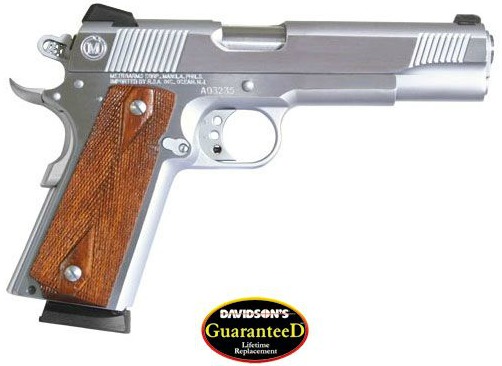 MetroArms (www.metroarms.com) pistols are manufactured in the Philippines and imported into the USA by Eagle Imports of Wanamassa, New Jersey. Eagle also imports Bersa Firearms and Comanche pistols. Roughly five years ago I reviewed a blued MetroArms American Classic II pistol for Guns and Shooting Online. At the time, I was impressed by the precise fit of the components. The slide to frame, as well as the barrel to slide and barrel to frame fits were all, in my opinion, superior. This was especially impressive given the gun's low retail price. Let's face it, no matter how much CNC steel cutting you use, it still is more expensive than molding plastic. These pistols represent good value for money if you are looking for a traditional, steel 1911. Some parts production costs are cut by the use of an investment (but fully machine finished) cast frame, as well as the use of MIM smaller components, including the hammer, sear, disconnector, safeties and slide stop. The barrel and slide are machined from from heat treated, high carbon, 4140 steel. I do recall mentioning that the pistol's slide and frame appeared to lack radiused or beveled corners, leaving sharp edges akin to a current Colt 1911, perhaps understandable at the Metro price. Although potentially hard on skin or holsters, it is hardly fair to criticize MetroArms for this small oversight. All told, it was a good quality product. A discussion that I had with the President of the Company in Manila was quite informative regarding the level of precision the company uses to create these pistols. There is a fair amount of hand fitting to ensure slop-free tolerances. Chuck Hawks, the Owner and Managing Editor of Guns and Shooting Online, requested a new, hard chrome plated version of the American Classic II pistol for this review. (Other finishes available in 2014 include blued and two-tone.) Our test pistol is chambered for the ever popular .45 ACP cartridge, although 9x19mm is also available. The Classic II differs from the (still available) standard American Classic by including a loop hammer, Novak style sights, lighter weight trigger, beavertail grip safety, extended thumb safety, extended slide stop and fish scale (rather than checkered) grip panels. Both models feature a hammer forged and throated barrel, straight (rather than curved) mainspring housing and flared ejection port. There are forward cocking serrations that match the pattern of the rear serrations. Fortunately, these do not extend into the thinner areas of the slide adjacent to the frame rails, which could create a stress riser and subsequent fracture of the slide during recoil. I do not personally have any use for forward serrations, but these are at least well executed and without notable sharp edges. Speaking of sharp edges, the company must have noted my comments (and no doubt others), as the new pistol sent to us for this review had these sharp slide and frame edges "melted." The hardwood used for the fish scale patterned grips has nicer color and grain than the earlier pistol. The stocks are radiused, so that they fit nearly flush with the frame at the terminus of their edges, a nice touch. The trigger is of medium length with three-holes and a slightly rounded, checkered surface. It is appropriate for a single action pistol. The trigger broke at approximately 5.25 pounds with a couple ticks of creep, but no over-travel. There is an over-travel Allen screw for adjustment, but I did not touch it, as it was set perfectly. If you hold the trigger to the rear, you should not feel any drag on the sear with the hammer notches when moving the hammer back and forth. The Novak style, high visibility metal sights allow only a little light around the front sight when it is aligned in the rear notch. This makes for more precise aiming, albeit slightly slower acquisition. A small Allen key must be loosened before the rear sight can be moved laterally in its dovetail. I like the lack of the full length recoil spring guide rod and the fairly small extended thumb safety. Another small nicety is that the magazine release button has been made about 1/16 inch longer and now sports a checkered face. This is intended to allow slightly faster and more positive magazine changes. The bottom of the eight round magazine incorporates a rubber bumper. The standard hammer has been replaced by a lighter, loop style hammer. The pistol exhibited better than average fitting. There was no vertical or lateral play of the slide and frame, no looseness of the barrel bushing in the slide and no vertical displacement of the barrel while pressing down on the barrel hood through the ejection port when the pistol was in battery. Unfortunately, I discovered that when the grip safety is depressed the rear frame tangs extended beyond the grip safety, thus possibly cutting of the web of the shooting hand on recoil, despite the well radiused inside surface of the frame tangs. Because of this manufacturing defect, which should have been caught in a quality control inspection at the factory, we had to return the pistol for replacement before our testing could begin. A replacement pistol arrived in about five weeks time. This second pistol has a serial number about one thousand numbers higher than its predecessor. Like our first sample, the replacement also has a smooth running and slop free action. The trigger has a trace of creep as delivered, with about a 5.5 pound trigger pull. I took the pistol down (but not completely) to examine the sear and hammer and to remove the shipping oil. I used a wire brush on the underside of the sear hook to remove a small burr visible only under a loupe and reassembled the pistol using Slip 2000 EWL full synthetic oil. With only a little over 1/32 inch of take up, a crisp break and no over travel, it is as good as or better out of the box than most semi-auto service pistol triggers. Quality of manufacture is there. The operating system is colloquially known as Series 70 by Colt, the original 1911 pistol manufacturer, in that it lacks a spring-loaded firing pin plunger safety and is exactly the same as John Browning designed. Specifications
The test pistol's hard chrome finish is very well executed. It is difficult for a commercial plating service to completely and uniformly plate a complex shape, such as a 1911 receiver, but MetroArms has succeeded. The plating on this pistol is deep and uniform, unlike what even good platers were able to accomplish a couple of decades ago. Of course, the external finish doesn't matter if the assembly of the pistol isn't up to snuff. Only considerably more expensive 1911 pistols (over $1200 MSRP) appear to compete with the level of fit and finish of the relatively inexpensive MetroArms American Classic pistols. A group excursion to the Izaak Walton Range south of Eugene, Oregon ensued for a test fire session with the American Classic II. The shooting chores were handled by Gunsmithing Editor Rocky Hays, Chief Technical Advisor Jim Fleck, Chuck Hawks and myself. Technical Assistant Bob Fleck served as range master, spotter and helped change targets. We had four types of .45 ACP ammunition on hand. These included MagTech 230 grain FMJ, Remington 230 grain FMJ, Winchester/USA 230 grain JHP and Winchester Supreme Elite 230 grain PDX1 Bonded JHP. Our thanks to our friends at Remington and Winchester Ammunition for providing ammo for this review. It would not be the same without their support. As usual, we did our shooting for record at 25 yards from a covered bench rest. The summer weather was warm, about 87-degrees F, with a high overcast. There was a variable, approximately10 MPH breeze, which we regarded as inconsequential for a .45 pistol at 25 yards. A Pistol Perch or Caldwell sand bag were used to stabilize the pistol, depending on shooter preference. (Two of us used the Pistol Perch and two chose the Caldwell bag.) We shot at Hoppe's 25 yard slow-fire, bullseye pistol targets. Due to the ongoing Obama Administration inspired ammunition shortage, we fired three shot (instead of our usual five shot) groups. Here are the results:
This time out, Jim shot the smallest single group, as well as achieving the overall smallest average group size. Jim and I are experienced 1911 shooters, while Chuck and Rocky have long, but thin, experience with 1911s and are not fans of the type, generally preferring more modern pistols. No malfunctions of any kind were experienced during the course of our shooting, which is better than average performance for the 1911 pistols we have reviewed. Credit MetroArms for producing a reliable pistol. Rocky found the trigger release inconsistent for bench rest target shooting, sometimes with one stage of creep and at other times with two stages of creep. However, he stated it would be fine for personal defense purposes. Jim thought the trigger release was adequate and Chuck thought it was good, although he prefers a smooth trigger face and criticized the checkering on the Classic II's trigger as being uncomfortably sharp. Chuck also prefers a spur hammer, as supplied on the standard American Classic model. He finds the Classic II's loop hammer more difficult and less certain to thumb cock than the original, Browning designed, type of hammer. We all appreciated the pistol's good machine work, fit and finish. Jim commented that the grip carving reminded him of snake skin, while it reminded Chuck of fish scales. Whatever you call it, we all agreed the grips provided a secure hold. Likewise, the slide serrations, which are somewhat coarser than on a Colt GI model 1911, provided a firm gripping surface. In fact, all of the gun's controls, including the slide release, magazine release and safety, were easy to use. After the shooting portion of this review was completed, I got bothered by that darn trigger and invested about another 20 minutes to do a quick trigger job. I used a very fine Arkansas stone and removed the factory roughness from the face of the sear, making sure I did not change the angles of either the sear or the hammer bearing surfaces. I removed a touch of the release portion of the sear, the inside curve as the hammer passes it when dropping onto the firing pin. I also polished the rear face of the disconnector as it slides up and down the rear of the trigger bow. Reassembled the pistol using synthetic lubricants. The pull weight is now about 4.0 to 4.25 pounds, not bad for a street gun. It seems to be consistent with no trace of the former creep when the trigger stops moving during the initial part of the sear break. Our overall impression of the MetroArms American Classic II 1911 pistol is positive. It looks good and works well, incorporating the modern features demanded by the majority of 1911 shooters. Given its high quality and modest retail price, it is a bargain. |