|
The .300 Winchester Magnum By Chuck Hawks 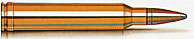 The Winchester .338 Mag. entered the market in 1958 and everyone expected Winchester to bring out a .30 caliber magnum based on their new case. However, Winchester waited several years to release their .300 Magnum. When the .300 Winchester Magnum was finally introduced in 1963, it was based on the .300 H&H case shortened to 2.62 inches (slightly longer than the .338 case). It had very little body taper and a short neck--all designed to allow the maximum powder capacity for a cartridge that would still run through standard length actions. This gives the .300 Win. performance not far behind that of the long .300 Weatherby. It is superior to the .300 H&H (as factory loaded) and marginally superior to the .308 Norma and .30-338 wildcat with bullets weighing 180 grains or less. Winchester factory loads give a 150 grain Power Point bullet a MV of 3290 fps and ME of 3605 ft. lbs. At 200 yards the figures are 2636 fps and 2314 ft. lbs. According to the 26th edition of the Hodgdon Data Manual handloaders can drive a 150 grain bullet to a MV of 3064 fps with 81.0 grains of H1000 powder, and at a MV of 3240 fps with 85.0 grains of H1000. These velocities were measured in a 26" test barrel A 165 grain bullet is probably a better choice for the .300 Win. Mag., given the powder capacity of the case and the superior sectional density (SD) of the heavier bullet. Winchester's factory load gives a 165 grain Fail Safe bullet a MV of 3120 fps and ME of 3567 ft. lbs. At 200 yards the figures are 2515 fps and 2319 ft. lbs. The trajectory of a 165 grain spitzer bullet at a MV of 3120 fps should look about like this: +3" at 100 yards, +3.4" at 200 yards, -1.2" at 300 yards, and -11.4" at 400 yards. According to the 26th edition of the Hodgdon Data Manual reloaders can drive a 165 grain bullet to a MV of 3031 fps with 79.0 grains of H1000 powder, and at a MV of 3207 fps with 84.0 grains of H1000. These velocities were also achieved in a 26" test barrel. 180 grains is the most popular bullet weight for the .300 Win. Mag. Winchester loads their 180 grain Power Point Plus bullet to a MV of 3070 fps and ME of 3,768 ft. lbs. At 200 yards the velocity is 2633 fps and the remaining energy is 2361 ft. lbs. Winchester trajectory tables show that the 180 grain Power Point Plus bullet zeroed at 200 yards rises only 1.4" at 100 yards and falls 6.4" at 300 yards. This is identical to the trajectory for the 130 grain Power Point Plus bullet in the famous .270 Winchester caliber. Obviously, Winchester's big .300 is a fine long range big game cartridge. According to the 26th edition of the Hodgdon Data Manual reloaders can drive a 180 grain bullet to a MV of 2945 fps with 78.0 grains of H1000 powder, and to a MV of 3121 fps with 83.0 grains of H1000. The latter load developed a pressure of 50,900 cup. Zero a typical 180 grain spitzer bullet (like a Nosler Partition) at a MV of 3070 fps so that it hits 3" high at 100 yards and the trajectory should look like this: +3" at 100 yards, +3.2" at 200 yards, -1.3" at 300 yards, and -11.4" at 400 yards. This method of sighting takes better advantage of the long range potential of the cartridge. 200 grains is the heaviest bullet factory loaded in the .300 Win. Typical factory loads give 200 grain bullets a MV of 2,800 to 2,900 fps. According to the Barnes Reloading Manual No. 1 with top loads handloaders can achieve velocities from 2700-2,773 fps with a 220 grain bullet (SD .331) and 2523-2,574 fps with a 250 grain bullet (SD .376). The very high sectional densities of these bullets give the .300 Win. Mag. the potential for extreme penetration, should it be needed. The .300 Winchester Magnum is by far the most popular of all the standard length .300 Magnums. It is one of only three magnum cartridges on most "top 10" best selling cartridge lists and the obvious choice for anyone contemplating the purchase of a .300 Magnum rifle. Along with the 7mm Rem. Mag. and the .338 Win. Mag., it is offered in more models of rifles than any other magnum cartridge and most other cartridges period. Ammunition is manufactured and widely distributed all across North America and around the world. |