|
Compared: .300 Winchester Magnum and .300 Weatherby Magnum By Chuck Hawks The first of the "Super .30" (as it was originally called) cartridges was the .300 H&H Magnum of 1920. Based on a necked-down version of the .375 H&H Magnum case, the .300 H&H Magnum, as it was known in America, remained the most popular of the big case .300s until factory loaded ammunition became available for the .300 Weatherby Magnum in 1948. Indeed, until then, it was the only .300 Magnum for which factory loaded ammunition was available. Roy Weatherby based his Super .300 on a full length, blown-out, .300 H&H case with the famous Weatherby double radius shoulder. Its design retains a fairly long neck which, with its large powder capacity, makes it excellent for the heavy 180-220 grain bullets that are (or should be) the most appropriate projectiles for any .300 Magnum. 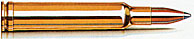 The .300 Weatherby became, and remains, the most popular of the Weatherby calibers. Until the much later introduction of hugely overbore .30 cartridges like the .300 Ultra Mag. and .30-378 Weatherby, the .300 Weatherby offered the highest performance in the caliber. It remains the most powerful .300 for which there is any real demand or purpose. It was joined by the .300 Winchester Magnum in 1963, which quickly became the best selling .300 Magnum of them all. The reason for the existence of the .300 Winchester was to provide .300 Magnum performance in a cartridge that would work through a standard (.30-06 length) action. At the time of its introduction, Winchester, FN/Browning, and Weatherby, among major manufacturers, offered rifles with actions long enough to accommodate a full (.375 H&H) length magnum cartridge, but most did not. So there was a real need for a "short magnum" as the .300 Winchester was then called. 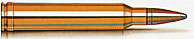 The advent of today's WSM and SAUM short magnums is more difficult to justify, since every major rifle manufacturer already has in production an action that will accept .30-06 and .300 Win. Mag. length cartridges. But I digress. Today there are a number of .300 Magnum cartridges offered to hunters who cannot live without a big case .300, but the Weatherby and Winchester versions remain the best known, best distributed, and most commercially viable. The .300 Winchester cannot match the ultimate performance of the .300 Weatherby, since its case has less powder capacity. But it is a powerful cartridge in its own right and comes closer to the performance of the .300 Weatherby than some shooters might imagine, and it kicks less. The comparison The .300 Win. Mag. and .300 Wby. Mag. are both factory loaded and ammunition is widely distributed. Federal Cartridge loads 180 grain Nosler Partition spitzer bullets (SD .271, BC .474) in their premium Vital-Shok line for both calibers, so we will use them to represent factory loads for both calibers. 180 grains is the most popular and probably the best all-around bullet weight for all .300 Magnums. To represent heavy bullet loads in both calibers we will use reloads taken from the sixth edition of the Hornady Handbook of Cartridge Reloading. These are maximum loads using the Hornady 220 grain Interlock RN bullet (SD .331, BC .300). We will compare these loads on the basis of velocity, energy, trajectory, killing power, recoil, and the availability of arms and ammunition. Since our selected loads for both calibers use the same bullets, sectional density (SD) and ballistic coefficient (BC) are identical. And all .30 caliber bullets have a cross-sectional area of .0745 square inches. So those variables need not be considered. Now, let's get started. Velocity Velocity is the most important component of energy and also decreases bullet flight time and hence flattens trajectory. Roy Weatherby, among others, thought it was also an important factor in killing power, although not all authorities agree with that thesis. Here are the velocities from the muzzle (MV) to 400 yards in feet per second for our 180 grain Federal Premium factory loads and our Hornady maximum reloads.
The .300 Weatherby has a velocity advantage at all ranges and with all bullet weights, as you might expect due to its larger case and greater powder capacity. This is most noticeable with the 180 grain bullet at 400 yards, where the big Weatherby cartridge has a surprising 400 fps advantage. We will soon see how much advantage this confers on the .300 Weatherby in other areas. Kinetic Energy Kinetic energy is a measure of the ability to do work. It is energy that powers a bullet's expansion and penetration in a game animal. Bullet penetration and expansion are very important factors in killing power. Here are the energy figures in foot pounds for our selected loads from the muzzle (ME) to 300 yards.
The .300 Weatherby carries more energy across the board. The Weatherby's advantage is most pronounced with the 180 grain factory loads because that is where the velocity differential is greatest. It puts more energy on target at 100 yards than the smaller .300 Winchester Magnum does at the muzzle. Trajectory Since bullet placement is, by far, the most important factor in killing power and .300 Magnums are generally thought of as long range cartridges, trajectory is a key factor. A flatter trajectory means that the shooter needs to make less compensation for bullet drop as ranges increase. Thus it is easier to get a bullet accurately into an animal's vital area and effect a quick, humane kill. The following trajectories, shown in inches above or below the line of sight, are computed for a 200 yard zero and assume a 24" barrel with an optical sight mounted 1.5" over bore.
Once again, the higher velocity of the .300 Wby. Mag. pays off, this time in a flatter trajectory. If you are buying your .300 for its long range capability, consider the full length .300 Weatherby. Another way to look at the trajectory of our two cartridges is that with 180 grain spitzer bullets the .300 Win. Mag. has a maximum point blank range (+/- 3") of about 290 yards. The .300 Weatherby Magnum, shooting a 180 grain spitzer, has a maximum point blank range (MPBR) of about 320 yards. (Read more about MPBR in the "Expanded Rifle Trajectory Table," which can be found on the Tables, Charts and Lists Page.) Killing Power Killing power is very difficult to estimate due to the great number of variables, not the least of which are the game animal's physical condition when hit and the effect of bullet expansion on the length and diameter of the wound channel. And the most important factor, as we have already noted, is bullet placement. That said, an approximation of killing power can be a useful tool when choosing a hunting cartridge. One of the best attempts to estimate killing power on game animals is the "Optimum Game Weight Formula" devised by Edward A. Matunas. It at least attempts to consider more than one factor and relates the result to the live weight of the animal and the distance at which it is shot. Most of all, OGW seems to have a positive correlation with results in the field. (There is an extensive OGW table on the Tables, Charts and Lists Page of Guns and Shooting Online.) Here are the Optimum Game Weight figures (in U.S. pounds) for our loads at 100, 200, 300, and 400 yards.
According to these OGW figures, and assuming good bullet placement, both of these cartridges are limited by their trajectory rather than their killing power on 500 pound (average weight) CXP3 game like Rocky Mountain elk. They have a 290-320 yard limit in terms of MPBR but both retain adequate killing power out to beyond 400 yards. The .300 Weatherby has greater killing power with both bullet weights, but it is hard to make practical use of it on game like elk and kudu. These numbers also illustrate why the 180 grain bullet is so popular in all of the .300 Magnum calibers. It shoots flatter, kicks less, and kills farther than the heavy 220 grain bullet. Unless extreme penetration is required (the 220 grain bullet does boast that .331 SD), a 180 grain projectile seems to be a better choice for most purposes. Recoil Recoil is the price a shooter pays for superior performance. That is why I always advise hunters not to buy more gun than they need. Everyone can shoot better with a rifle that kicks less, and bullet placement is far more important than raw power. To compute recoil you need to know the rifle weight, bullet weight, MV, and the weight of the powder charge. Such computations are approximate, but adequate for our purposes. A scoped Weatherby Vanguard Stainless rifle in either .300 Win. Mag. or .300 Weatherby Mag. weighs about 8.5 pounds, and that is pretty typical for .300 Mag. rifles, so that is the rifle weight that we will use to compare recoil. We have all the information needed to calculate recoil except the powder charge used in the Federal factory loads. Federal, like other ammunition companies, doesn't reveal how much powder they use in their factory loads. However, we can make a pretty well educated guess based on the data published in the Nosler Reloading Guide. For comparison, a typical .30-06 rifle shooting a 180 grain bullet at a MV of 2700 fps delivers about 20 ft. lbs. of recoil energy, and that is considered the maximum most experienced shooters can handle. Here are the approximate recoil energy (in foot pounds) and recoil velocity (in feet per second) figures for our loads.
These figures are well over the 20 ft. lb. maximum. The .300 Weatherby has always been known as a particularly hard kicking caliber. That big case (and very high operating pressure) makes a higher level of performance possible, but it also means that it's not much fun to shoot. The fact is that all .300 Magnums kick hard, too hard for most shooters to shoot well. As is widely known among guides and outfitters, most hunters with .300 Magnum rifles shoot them poorly. Buyer beware. Availability of Arms and Ammunition This is the other area (besides recoil) where the .300 Win. Mag. is superior to the .300 Wby. Mag. .300 Weatherby ammunition is available all over the world where big game animals are hunted. And rifles in the caliber are widely distributed. But, the same is true of .300 Win. Mag. cartridges and rifles, and the selection of the latter is much broader. Federal, for example, offers 10 different factory loads in .300 Winchester, but only 3 loads in .300 Weatherby. Not only is there more selection in .300 Win. Mag. ammo and rifles, the prices are generally lower, particularly for factory loaded ammunition. For the handloader, once he or she has a reasonable supply of brass, the difference in ammunition cost is much closer to parity. Summary and Conclusion Probably the best reason to buy a .300 Weatherby Magnum rifle is that there are a reasonable number of good Mark V Weatherbys available on the used market--more in .300 Wby. Mag. than any other caliber. These outstanding rifles are now so expensive brand new as to be beyond the reach of many hunters, so a used Mark V is the only alternative for most of us. If you just can't live without a .300 Magnum rifle, a good used Mark V is pretty hard to beat. On the other hand, the .300 Win. Mag. cartridge is offered in more brands and models of rifles, and can be had in lever action and autoloading rifles as well as bolt guns. It is the best selling .300 Magnum cartridge in the world. .300 Win. Magnum ammo is quite a bit cheaper and easier to find. It even goes on sale occasionally. So if you don't particularly want a Weatherby Mark V rifle, and can live without the extra performance the .300 Weatherby cartridge offers, the .300 Winchester Magnum is probably the more practical choice. |