|
The .38 Long Colt By Mike Hudson The .38 Long Colt cartridge has been the object of derision in the gun press for longer than any of us even remember. Its main claim to shame is that it so lacked in stopping power that the fanatical Moro tribesman of the Philippines were capable of digesting a cylinderful and go on to lop the head off of the unfortunate U.S. Army officer who�d shot him. Reading some accounts of the Philippine War today, one could easily get the impression that the Moro fighter armed with a three-foot bolo machete was better equipped than American soldiers carrying Krag rifles and the Colt .38�s. The uproar led to the reinstatement of the .45 caliber as the American service cartridge, a round that, as the .45 ACP, remains as a substitute standard service cartridge even today. So just how bad was it? How might it compare to rounds now being used in self-defense weapons by millions of Americans? The .38 Long Colt cartridge was brought out in 1875 for use in the famous Single Action Army revolver and became an institution two years later when Colt designers paired it with the first double action produced by the company, the Colt Lightning model. The original black powder loading fired a 150-grain pure lead bullet at 770 feet per second, producing 201 pounds of muzzle energy. Sales of the Lightning were phenomenal and the future of the round looked bright. In 1889 Colt introduced the
first in its series of swing-out cylinder, double action revolvers collectively
known today as the New Army and Navy series. The swing-out cylinder eliminated
the rod ejector system employed by both the Single Action Army and the
Lighning, making reloading a much less laborious process. The New Army and Navys
underwent a series of minor improvements in 1892, 1894 and 1896. To the
untrained eye, these later models are almost indistinguishable from Colt�s
Official Police revolver, which continued in production until 1969. 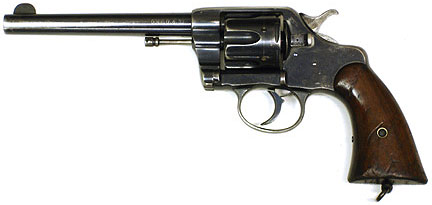 The Navy purchased 5,000 of
the .38 revolvers in 1889 and the Army quickly followed suit, replacing all of
their Single Action Army .45�s with the new weapon. The novice pistolero was
far more easily trained in the use of the lighter cartridge and it was felt
that the ability to rapidly reload more than offset the liability of using a
less powerful round. It should be remembered
that, during the final 20 years of the 19th Century, armies the
world over were downsizing the calibers of their small arms. Revolvers in .32
or even .30 caliber were in widespread use by the French, Russian, Swiss and
other continental militaries and most cops patrolling the streets America�s
cities were likewise armed with .32 caliber handguns. The Colt .38�s got their
first taste of blood in the Spanish-American War of 1898. There were no
complaints and returning veterans gave a good account of the new Colts. It was
only in 1899, when America decided to go empire building in the Philippines,
that the trouble began. The Moro warriors were
Muslim fanatics, not too far removed from the terrorists being faced by American
soldiers in Iraq and Afghanistan today. To make matters worse, the Moros had
been fighting the Spanish for more than 20 years when the first Americans
arrived. Gen. John �Blackjack�
Pershing was a young captain when he was sent to Manilla and the Colt .38
impressed him so much that he ordered them issued to his men in the Mexican War
of 1916 and subsequently World War I, despite the fact that the 1911 Colt .45
automatic had become widely available. However, the soldiers
grumbled, as soldiers are wont to do. Some of them claimed not only that the
Colt .38�s lacked sufficient stopping power, but that the .30-40 Krag rifles
they�d been issued also weren�t up to the task. Overlooked by many gun writers
is the fact that many if not most of these troops were green recruits, poorly
trained and quite likely lacking in the marksmanship department. Surely the Krag�s record in
the hunting field, where it has successfully taken game ranging from Alaskan
brown bear to buffalo, would indicate it has more than enough power to drop a
small-statured Philippino adversary. However, the newspapers of
the day played up the controversy. The military responded by bringing some old
Single Action Army� .45�s out of
mothballs and purchasing several thousand of the old Colt rod-ejector .45
double actions for issue to the troops. They also established the
Thompson-LaGarde Commission of 1904, which, after testing various rounds on
live cattle, concluded that the .45 was the best bet for a combat handgun. �The Board was of the opinion
that a bullet, which will have the shock effect and stopping effect at short
ranges necessary for a military pistol or revolver, should have a caliber not
less than .45," the board concluded. (The Commission's report actually
showed that none of the pistol cartridges tested were effective at killing
cattle; the recommendation to switch to .45 caliber was based entirely on
pre-existing bias. -Ed) In 1911 the New Army and Navy revolvers were replaced by new Colt autos as
the standard military handgun, although they remained in government service for
years to come. In addition to WW I, they soldiered on into the 1920�s and 30�s
and thousands were shipped to Great Britian under the Lend-Lease program in
World War II. Because of their use on U.S. Coast Guard vessels during that
conflict, the old Colts are listed as �substitute standard� by historians and
collectors of arms from that war. Let�s get down to brass tacks. Do guns chambered for the .38 Long Colt
cartridge have any place in the world of personal civilian defense today? Sure
they do. Currently, the round is being produced by the Black Hills, Goex, Ultramax
and Ten-X ammunition companies, and it also available through some of the
custom ammunition makers like Stars & Stripes and Gad Custom Ammunition.
Prices range from $18 to $32 a box, so do some shopping. The cartridge�s
revival has been do to the popularity of Cowboy Action Shooting and the
plethora of single action weapons based on the old 1851 and 1861 Navy madel
cartridge conversions. The Ultramax fires a 158-grain, flat nose, lead bullet at 700 fps. The
Black Hills fires the same bullet at 650 fps and the others use 145 or 150
grain bullets at 650 to 710 fps. I prefer the Ultrmax and its 210 foot-pounds
of muzzle energy for social work. This beats the pants off any .32 ACP on the market and also leaves standard velocity loadings of the .380 ACP. Its muzzle energy is comparable to the Cor-Bon .380 Self Defense 98-grain JHP loading, athough the much heavier bullet of the .38 Colt would get the nod for its superior penetration. Likewise, the .32 H&R Magnum Personal Defense load offered by Federal produces muzzle energy similar to the .38, though in my view the old Colt round�s larger diameter and far heavier bullet would win the day. Other comparable cartridges include the 9x18 Makarov and the 148 grain wadcutter load offered in .38 Special. All of these rounds have been employed in the role of self defense and there is no reason that the .38 Long Colt should not be considered among them. The Colt New Army and Navy revolvers are a bargain on today�s gun market, often selling for around $200. Get youself one in good condition and you�ll have a fine double action revolver that is perfectly suited for night-stand duty and is a collector�s item as well. |